Symptom Guides
Dishwasher Not Draining? Fix It
By Michael Smith — Head Technician · September 18, 2026 · 7 min read
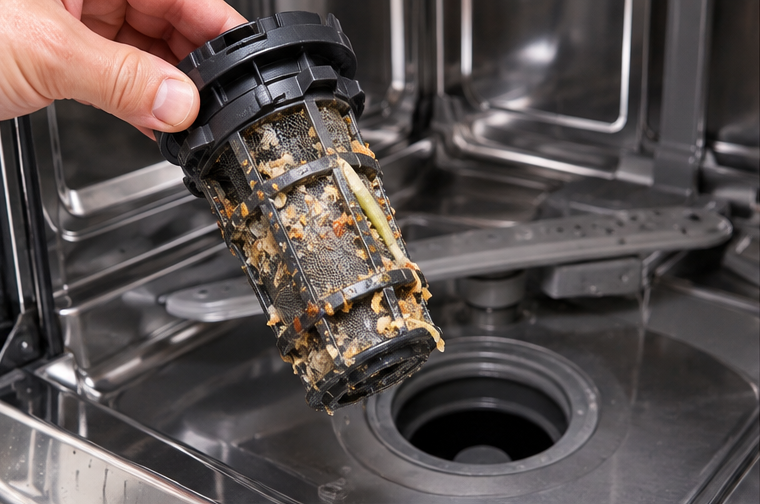
A dishwasher not draining is usually blocked rather than broken. Check the filter at the bottom of the tub, the drain hose high loop, and the air gap on the sink deck. If a garbage disposal was recently installed, the knockout plug may still be in place, which blocks drainage completely.
What a Dishwasher Not Draining Usually Means
First, calibrate what counts as a fault. A cupful of clean water sitting in the sump at the bottom of the tub after a cycle is normal on many models — it keeps seals from drying out. A dishwasher not draining means something different: standing dirty water covering the tub floor, dishes that come out with grit or film, or water that visibly backs up when the cycle ends. Once you are looking at the second category, the cause is nearly always a restriction somewhere along a short and very accessible path: tub filter, drain hose, disposal connection, air gap, pump. Almost every one of those points is reachable without tools or with nothing more than a screwdriver, which is why this is one of the better appliance problems to attempt yourself before calling anyone.
The Five Things to Check, in Order
The Filter at the Bottom of the Tub
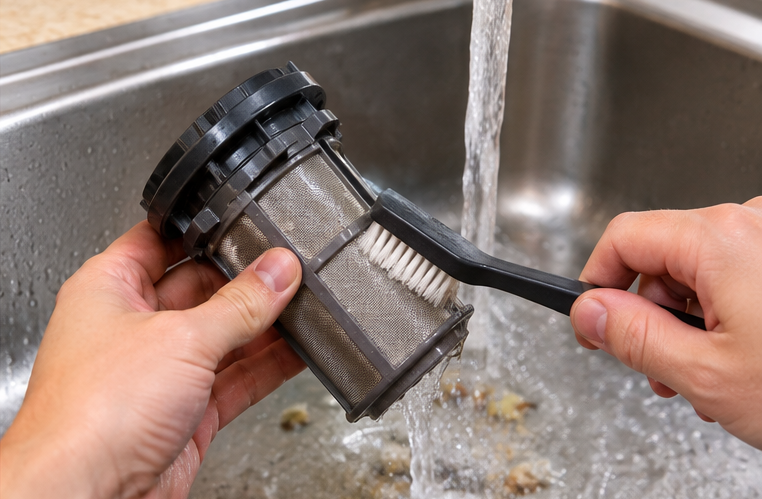
Most dishwashers built in the last fifteen years use a manual filter rather than a self-cleaning grinder, and a great many owners have never removed it. It twists out by hand. Under it you will typically find a fine mesh screen and a coarse cup that collects labels, seeds, bone fragments and broken glass. A filter matted with grease and food debris slows drainage first and stops it eventually, and it also explains the related complaint of dishes coming out dirtier than they went in. Rinse it under hot water with a soft brush, and make it a monthly habit rather than an emergency measure.
The Drain Hose and Its High Loop
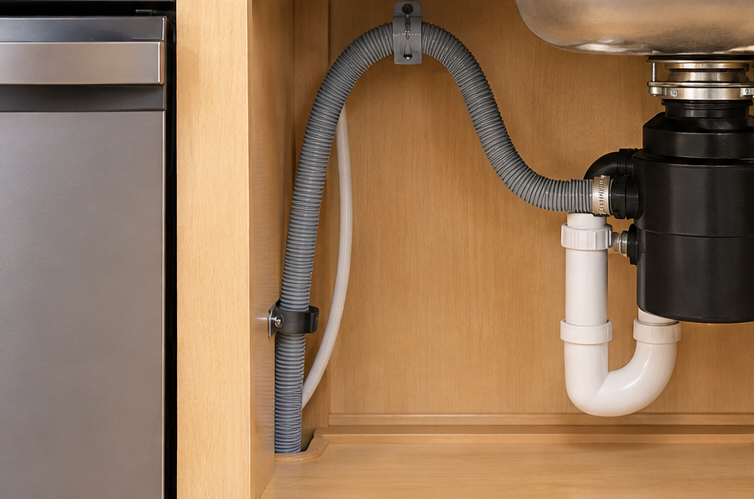
The dishwasher drains upward into either a garbage disposal inlet or a dedicated sink tailpiece, and the hose between them must rise to a high loop under the counter before dropping down. That loop is what stops sink water from siphoning back into the tub. If the hose has been crushed behind a newly installed cabinet, or the loop has slipped down during a plumbing job, you get slow drainage or standing water that reappears after every sink use.
A New Disposal With the Knockout Plug Still In
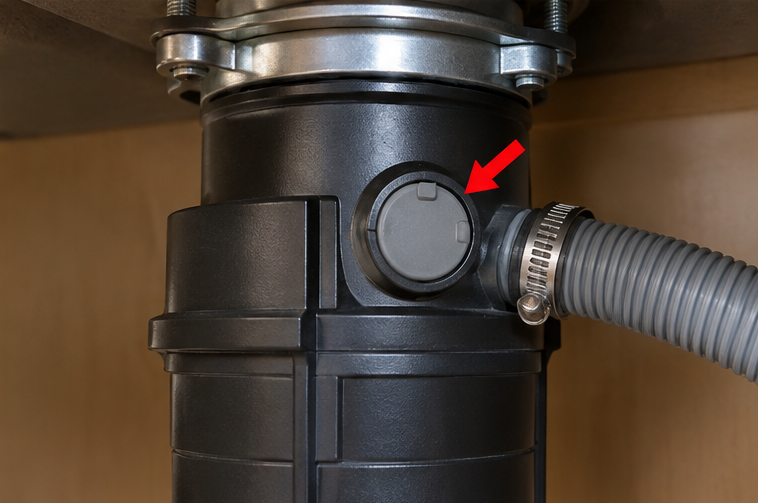
This one is worth knowing because it is so common and so completely invisible. A new garbage disposal ships with a solid knockout plug sealing the dishwasher inlet, because not every installation uses it. If nobody knocks that plug out during installation, the dishwasher drain hose is connected to a sealed port and the machine cannot drain at all. The symptom appears immediately after a kitchen upgrade, which is the tell: if your dishwasher drained fine until the week a disposal was replaced, check this before anything else.
The Air Gap on the Sink Deck
That small chrome cylinder beside the faucet is not decorative. It is an air gap, and it prevents dirty sink water from being drawn back into the dishwasher. Its cap lifts off and the interior can be cleared with a bottle brush. A clogged air gap typically shows itself by spitting water onto the counter during the drain cycle, so if you see that, you have found your restriction without opening anything else.
The Drain Pump and Check Valve
If the filter, hose, disposal port and air gap are all clear, the remaining candidates are the drain pump itself and the check valve that stops water flowing back into the tub. A pump that hums without moving water usually has debris — often a shard of glass or a fruit sticker — jammed in the impeller. A failed pump is normally silent during the drain portion of the cycle. Both are inside the machine and both are where the do-it-yourself part of this list ends.
Why Rinsing Habits Changed the Rules
Two things shifted over the last two decades. Detergents were reformulated, and modern dishwashers use far less water per cycle than older machines. Both changes reward scraping plates rather than rinsing them, because the detergent needs some soil to work against, and the machine has less water available to carry debris away. The practical consequence for drainage is that whatever you do not scrape off ends up in the filter, and a filter nobody cleans is the beginning of most no-drain calls. Heavy pre-rinsing does not prevent that; regular filter cleaning does. If you are running short cycles with heavily soiled dishes, expect to clean the filter more often, not less.
Rockland County Kitchens and Older Plumbing
Kitchens across New City, Nanuet and Nyack cover a wide age range, and the plumbing under the sink often tells you more about a drainage problem than the dishwasher does. In houses where a dishwasher was added to a kitchen that was not originally built for one, the drain line can be routed in ways a modern installer would not choose: no high loop, a long horizontal run, or a connection into a partially blocked older trap that drains slowly on its own. If the sink beside the dishwasher also drains slowly, the fault is probably shared plumbing rather than the appliance.
The useful test is simple. Run the sink alone and watch how quickly it clears. If it backs up or gurgles, address that first, because a dishwasher pumping into a restricted drain line will keep failing no matter how many parts get replaced. This is one of the few appliance faults where the right answer is sometimes a plumber rather than an appliance technician, and it is worth knowing which you need before you book either.
What Not to Do While It Is Blocked
Three habits turn a blocked dishwasher into a worse problem. The first is running cycle after cycle hoping it clears itself. A drain pump straining against a blockage is doing the same damage a washer pump does in the same situation, and a machine that would have needed a filter cleaned can end up needing a pump. The second is pouring chemical drain cleaner into the tub. Those products are formulated for sink traps, not for a dishwasher's pump seals, hoses and food-grade plastics, and they can damage components that were never the problem in the first place. If a blockage sits in the shared sink drain, it needs to be cleared from the sink side.
The third is bailing the standing water out and calling it solved. Removing the water treats the symptom and hides the fault, and it means the next cycle starts by adding fresh water on top of a restriction that is still there. If you do need to empty the tub before working on it — and you usually do — use towels and a cup, disconnect the power at the breaker or the plug first, and treat that as step one of the repair rather than the repair itself.
When to Stop and Call
Stop when the accessible checks are exhausted. If the filter is clean, the hose is intact with a proper high loop, the disposal port is open, the air gap is clear and the sink drains normally, the remaining causes are internal: the pump, the check valve, the drain solenoid or the control board. Those require removing the lower access panel and testing components electrically, and on many models the machine has to come out from under the counter to reach them.
At that point, book a dishwasher repair rather than keep going. Bring what you have already ruled out to the call — it genuinely shortens the visit, and it means the technician starts at the pump rather than repeating the five checks you have already done. Meanwhile, do not keep running cycles hoping it clears: a dishwasher that cannot drain will simply refill and sit, and standing water in a warm tub becomes an odour problem within a couple of days.
- dishwasher
- drain hose
- air gap
- garbage disposal
- rockland