Symptom Guides
Dryer Not Heating: The Causes in Order, and the One That's a Fire Risk
By Michael Smith — Head Technician · October 22, 2026 · 7 min read
A dryer that runs but doesn't heat usually has a half-tripped breaker (electric), a closed gas valve or failed igniter or valve coils (gas), a blown thermal fuse, or a broken heating element. A blown fuse almost always means a blocked vent, which is also the leading cause of dryer fires.
A dryer not heating usually still tumbles, so the problem hides until you open the door to damp clothes. The good news is that the causes come in a predictable order, and the first few take minutes to check. The bad news is that one of them, a blocked vent, is also the leading cause of dryer fires. This guide goes through them in the order we check on a service call, for electric and gas dryers.
Need it fixed today? Call or text (800) 631-0109, 24/7, or book online. We repair dryers across North Jersey, Rockland, Westchester and Fairfield.
Why is my dryer not getting hot? Rule out the simple things first
The setting. "Air fluff", "air dry" and some delicate or wrinkle-release settings run with little or no heat. Try a normal timed dry on high.
The lint filter. A packed filter cuts airflow so much that some dryers shut the heat off to protect themselves. Clean it every load.
The load. An overloaded drum, or clothes that come out of the washer soaking wet, can take two cycles even when the dryer is fine. If the washer isn't spinning water out properly, the problem may be the washer, not the dryer.
Electric dryer not heating: check the breaker
Electric dryers run on 240 volts, which arrives on two separate lines through a double breaker. The drum motor needs only one of them; the heating element needs both. So if one half of the breaker trips, the dryer turns, the light comes on, and nothing gets warm. It's one of the most common reasons we hear "it runs but there's no heat".
Find the dryer's double breaker in the panel. Even if it looks on, switch it fully off and then back on. If the heat comes back and the breaker trips again later, there's a fault drawing too much current, often in the element or the cord connection, and it needs a technician.
Gas dryer not heating: gas, igniter or valve coils
Gas dryers use a standard 120-volt outlet for the motor and controls, and gas for the heat. Check that the gas shutoff valve behind the dryer is open; it often gets nudged closed when the dryer is moved. If it's open, start a cycle and look through the small window at the bottom front, if your model has one:
The igniter glows but no flame appears: the gas valve coils have usually failed. They're a common, inexpensive repair.
The igniter never glows: the igniter itself, the flame sensor or a thermal fuse is the likely cause.
The flame lights, then goes out quickly and the dryer stays cool: weak valve coils again, or an overheating cut-off reacting to a blocked vent.
If you ever smell gas, don't touch switches. Leave the house and call your gas utility from outside.
[PHOTO 1 · shot: the burner area of a gas dryer, or the heating element housing of an electric dryer, from a local job · alt text: "Checking why a dryer is not heating: gas dryer igniter and valve coils"]
The dryer thermal fuse, and why it blew
Every dryer has a thermal fuse: a small safety part that blows when the dryer gets too hot. Depending on the model, a blown dryer thermal fuse either stops the heat or stops the whole dryer from starting. Replacing it is simple. The important part is asking why it blew, because thermal fuses almost never fail on their own. The usual reason is restricted airflow from a blocked vent. Replace the fuse without clearing the vent, and the new one will blow too, or worse.
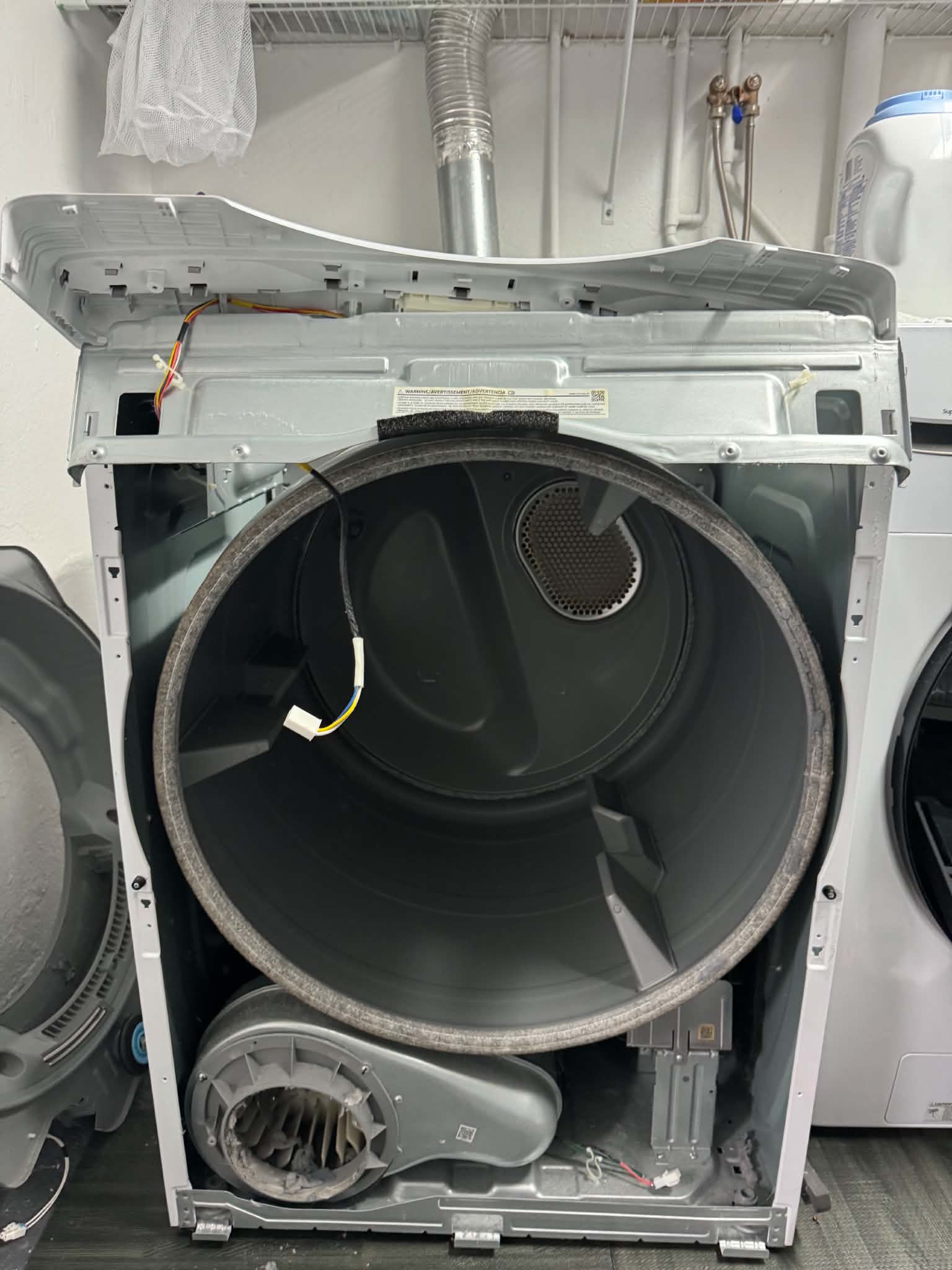
The dryer heating element (electric models)
The heating element is a coil of resistance wire inside a metal housing. Over time the wire breaks, often after years of running hot because of a partly blocked vent. A broken element means no heat at all. A technician confirms it with a meter before replacing it, because a fuse, a thermostat or the breaker can produce exactly the same symptom.
The rarer and more dangerous failure is the opposite: an element that shorts to the housing and keeps heating even when the cycle should have stopped. If your dryer stays hot after it shuts off, or keeps heating on the air-only setting, unplug it and stop using it until it's checked.
Thermostats and sensors
Dryers keep temperature in range with a cycling thermostat, and they protect themselves with a high-limit thermostat. Newer models use a temperature sensor called a thermistor. When one of these fails, the dryer may not heat, may heat weakly, or may cut out early. These are inexpensive parts, but finding which one has failed takes testing, not guessing.
The one that's a fire risk: a blocked dryer vent
Lint is highly flammable, and some of it always gets past the filter into the vent. According to the U.S. Fire Administration, about 2,900 clothes dryer fires are reported in homes each year, and failure to clean is the leading factor. Those fires peak in the fall and winter months, with the most in January.
The warning signs of a blocked vent:
Clothes take two cycles, or come out hot but still damp.
The top of the dryer, or the laundry room, gets unusually hot.
A burning or scorched smell.
The flap on the outside vent hood barely opens when the dryer runs.
Your dryer warns you: LG's d80, d90 and d95 codes mean the vent is roughly 80, 90 or 95 percent blocked. See our LG repair page for what to do.
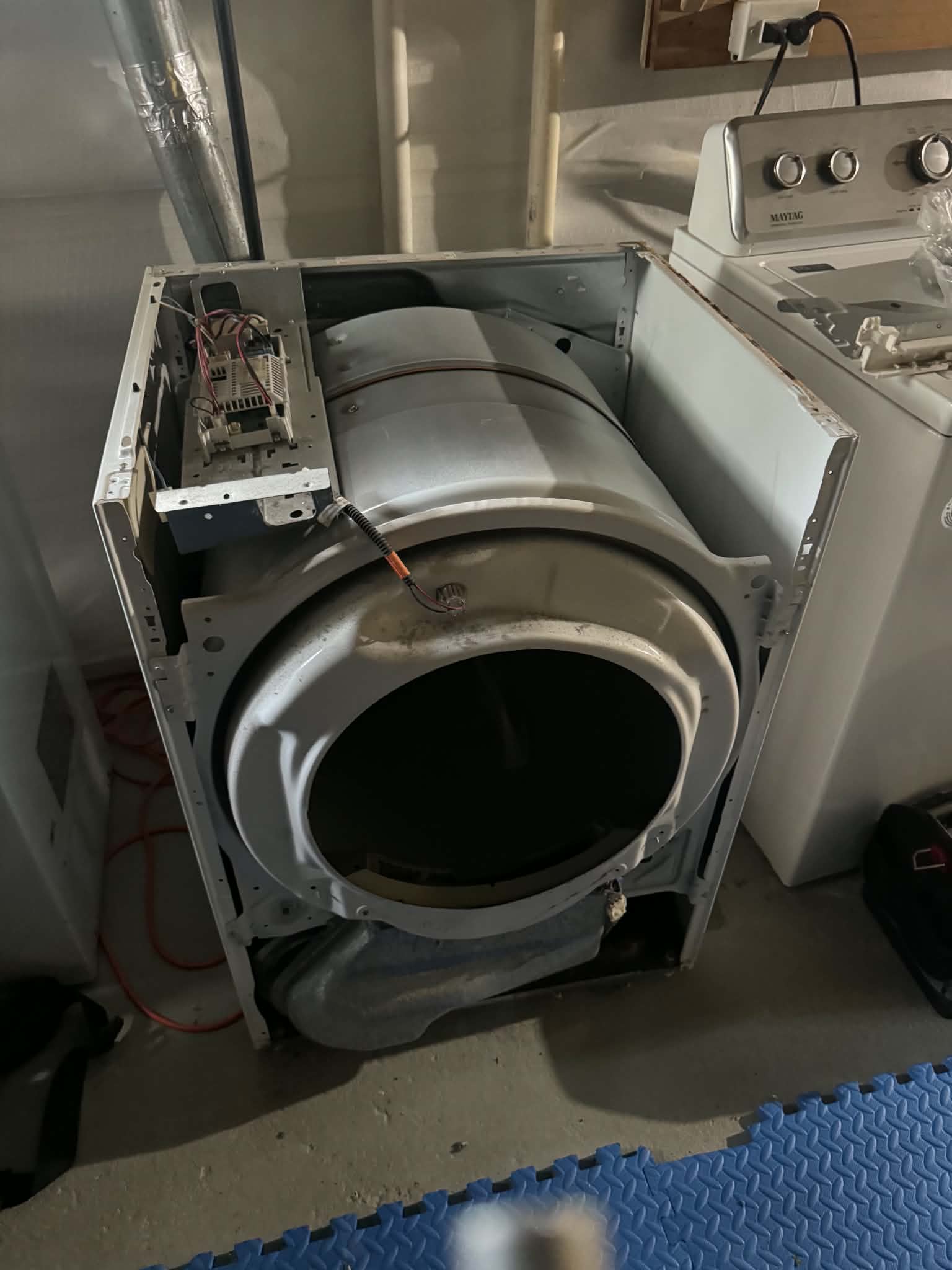
How long can a dryer vent be?
The residential building code's default limit for a standard 4-inch rigid metal vent is 35 feet, reduced by 5 feet for every 90-degree turn and 2.5 feet for every 45-degree turn, unless the dryer's installation manual allows a longer run. In practice, a vent with three or four bends and a long horizontal run across a basement can be well past its limit. That's common in older homes and split-levels where the laundry sits far from an outside wall.
Two other things matter as much as length. Use rigid or semi-rigid metal duct, not white vinyl or thin foil accordion hose, which sags, traps lint and can burn. And keep the short connector behind the dryer from getting crushed when the dryer is pushed back. Have the full vent run cleaned at least once a year, more often for a busy household.
[OWNER FACT · fill in before publishing, from his own jobs, no prices: "On no-heat calls, the cause we find most often is ___, and about ___ in ___ of them also have a blocked or overlong vent."]
Is a dryer not heating worth repairing?
Almost always. Thermal fuses, heating elements, igniters, valve coils and thermostats are inexpensive parts, and most no-heat repairs take one visit. Replacement only makes sense when the dryer is very old and has several worn parts at once, such as the drum bearings, rollers and motor. Our dryer repair page explains how we diagnose first and give you a written estimate before any work, and our dryer troubleshooting page covers other symptoms, from noise to a dryer that won't start.
Age matters less than you might think. Dryers are simple machines, and a typical dryer lasts around 13 years. A dryer under about ten years old with a no-heat fault is almost always worth fixing. On an older one, we look at the drum bearings, rollers, belt and motor at the same visit, so you know whether another repair is likely soon before you decide.
[PHOTO 2 · shot: a blown thermal fuse or a broken heating element next to the new part · alt text: "Dryer thermal fuse that blew because of a blocked dryer vent"]
When to stop and call
The breaker trips again after you reset it.
You smell burning, or the dryer stays hot after the cycle ends.
You smell gas. Leave first, then call the gas utility.
You've cleaned the filter and checked the breaker or gas valve, and there's still no heat.
Whoever repairs your dryer should check the vent too, because a new part won't last on a dryer that can't breathe.
- dryer not heating
- dryer thermal fuse
- dryer heating element
- dryer vent
- gas dryer