Symptom Guides
Why Your Fridge Isn’t Cooling
By Michael Smith — Head Technician · September 15, 2026 · 13 min read
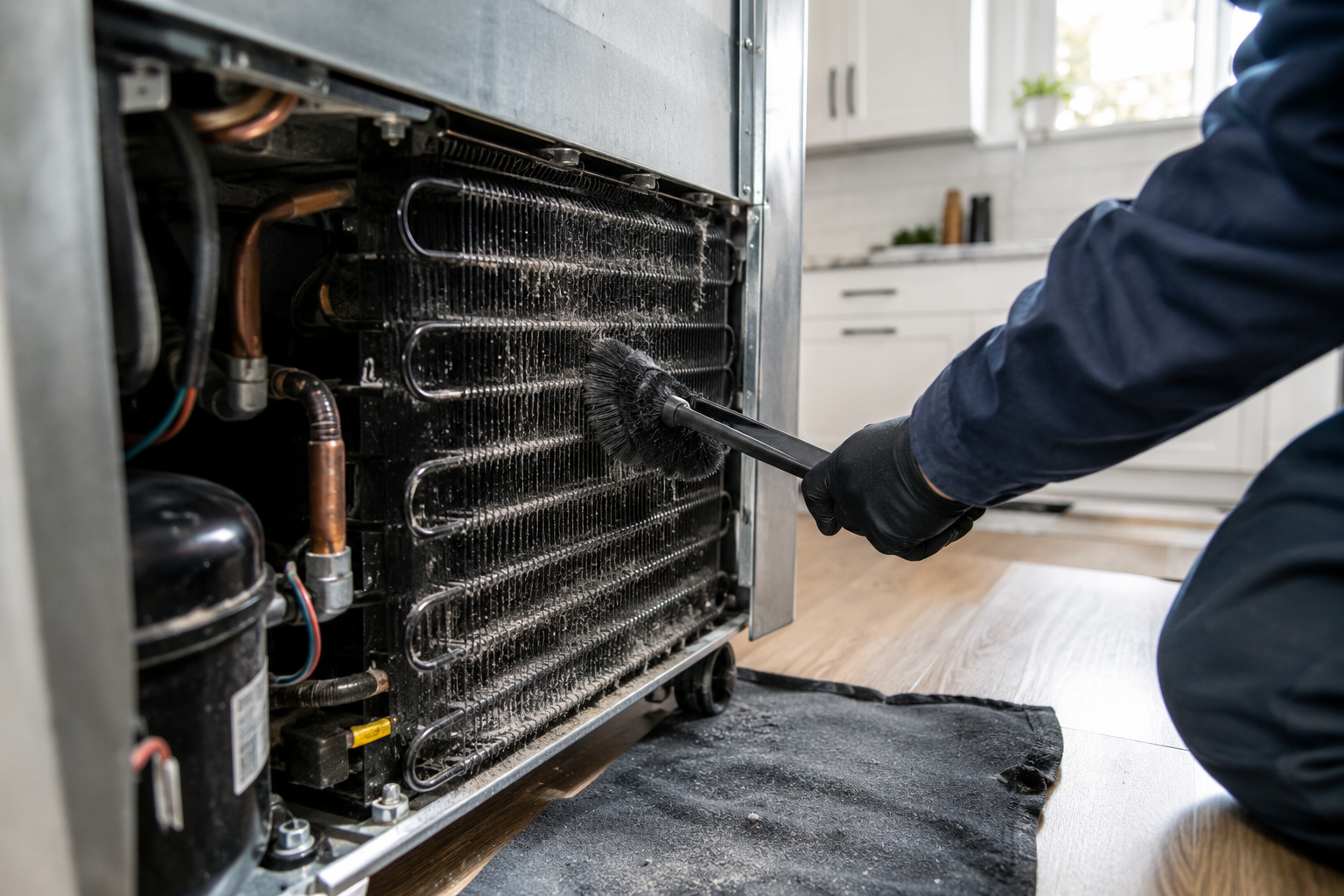
A refrigerator that runs but does not cool usually has a restricted airflow problem, not a dead compressor. Dirty condenser coils, a failed evaporator fan, a frost-blocked vent, or a worn door gasket account for most cases. Check the coils and door seal first, then call a technician if the compartment stays above forty degrees.
Refrigerator Running but Not Cooling? 7 Common Causes and What to Check
A refrigerator that is running but not cooling properly can be frustrating, especially when the lights are on, the compressor is humming, and everything appears normal from the outside. You may notice that drinks are no longer cold, fresh food is warming up, or the freezer is working while the refrigerator compartment is not.
Although this problem can sometimes be caused by something as simple as dusty condenser coils, it may also indicate a failed fan, blocked airflow, a faulty temperature sensor, or a problem with the sealed cooling system.
The good news is that you can perform a few basic checks before calling a technician. Understanding the symptoms can also help you describe the problem accurately and avoid unnecessary part replacements.
What “Running But Not Cooling” Actually Tells You
A refrigerator that hums along normally—with its interior light on, control panel working, and compressor apparently running—is giving you useful information before anyone opens a panel.
However, hearing the refrigerator run does not necessarily mean that the compressor and cooling system are working correctly. A compressor can run continuously without producing enough cooling because of a mechanical fault, a refrigerant leak, or another problem within the sealed system.
The important distinction is between a refrigerator that has no power at all and one that has power but cannot maintain the correct temperature.
If the refrigerator is completely silent, the issue could involve the power supply, thermostat, control board, or another electrical component. If it runs but the food compartment remains warm, the problem may involve:
Restricted airflow.
Dirty condenser coils.
A failed evaporator fan.
Excessive frost around the evaporator or air ducts.
A damaged door gasket.
A faulty temperature sensor.
A compressor or sealed-system problem.
The symptoms can help narrow the possibilities, but they cannot confirm the exact cause on their own. A refrigerator that runs constantly, for example, might have a dirty condenser, a leaking door seal, or a more serious cooling-system fault.
That is why a proper diagnosis is important before replacing expensive components.
The Seven Most Common Causes, Ranked by Frequency
1. Dirty Condenser Coils
The condenser coils release the heat that the refrigerator removes from the food compartments. Depending on the model, these coils may be located behind a lower front grille, underneath the appliance, or along the back.
Over time, dust, pet hair, cooking grease, and other debris can accumulate on the coils. When this happens, the refrigerator may struggle to release heat efficiently.
The compressor may then run for longer periods in an attempt to maintain the correct temperature. In some cases, the refrigerator becomes noticeably warm even though it continues to operate.
Common signs include:
The refrigerator runs almost continuously.
The sides or back of the appliance feel unusually warm.
The freezer is not maintaining its normal temperature.
Dust is clearly visible around the lower grille or rear components.
Dirty coils are among the easiest problems to prevent. Cleaning the accessible condenser area periodically can help maintain efficient operation, although the exact maintenance requirements depend on the refrigerator model.
What you can do: Disconnect power before cleaning accessible areas, and use a suitable coil brush or vacuum attachment. Avoid bending delicate tubing or damaging electrical components. If cleaning does not improve cooling, another fault may be involved.

2. A Failed Evaporator Fan
Behind the rear panel of many refrigerator freezers is an evaporator fan. Its job is to circulate cold air across the evaporator coil and distribute that air through the freezer and refrigerator compartments.
When this fan stops working, cold air may no longer circulate properly. The freezer can sometimes remain relatively cold while the fresh-food compartment gradually becomes warmer.
Possible signs include:
The refrigerator section is warm, but the freezer still appears cold.
You hear the compressor running but do not hear the usual fan noise.
Airflow from the refrigerator vents is weak or absent.
The appliance makes unusual buzzing, scraping, or clicking sounds.
The fan may be blocked by ice, obstructed by debris, or affected by a failed motor. Some models also stop the fan when a door is opened, so simply opening the freezer door may not be enough to determine whether it works.
The fresh-food compartment depends on proper airflow to maintain its temperature. If the evaporator fan is not circulating air correctly, the refrigerator may continue running without cooling the food properly.
3. A Frost-Blocked Air Duct or Damper
Cold air must travel between different sections of the refrigerator. In many models, air moves from the freezer through a duct or adjustable damper into the fresh-food compartment.
When this passage becomes blocked by frost or ice, cold air may not reach the refrigerator section—even if the compressor and evaporator fan are operating.
This problem can develop for several reasons:
A freezer door was left slightly open.
A door gasket is allowing warm, humid air inside.
The automatic defrost system is malfunctioning.
Food is blocking an air vent.
The air damper is stuck or damaged.
You may notice that the freezer remains cold while the refrigerator section becomes progressively warmer. You might also see unusual frost around the rear freezer panel or air vents.
Do not attempt to chip away heavy ice with a knife or sharp object. Doing so can damage internal components or refrigeration tubing. If frost repeatedly returns after the appliance is defrosted, the underlying cause should be investigated rather than treating the ice alone.
4. A Worn or Damaged Door Gasket
The rubber gasket around a refrigerator door creates a seal that keeps cold air inside and prevents warm, humid room air from entering.
A gasket may look fine from a distance but still fail to seal correctly. It can become cracked, flattened, loose, or pulled away from the door frame.
When warm air leaks inside continuously, the refrigerator has to work harder to maintain its temperature. This can lead to:
A refrigerator that runs almost nonstop.
Moisture or condensation around the door.
Frost developing in unusual areas.
Food becoming warmer than expected.
A door that does not close properly.
A simple paper test can help identify a possible sealing problem. Place a sheet of paper between the gasket and the frame, close the door, and gently pull the paper. Repeat the test at several points around the seal.
If the paper slides out very easily in multiple areas, the gasket may not be sealing properly. This test is only an indication, not a definitive diagnosis.
Also check whether shelves, food containers, or drawers are preventing the door from closing completely.
5. A Failing Start Relay or Run Capacitor
The compressor is responsible for circulating refrigerant through the refrigerator's cooling system. It relies on electrical components to start and operate correctly.
Depending on the refrigerator design, a start relay, run capacitor, or related starting component may help the compressor motor begin operating.
When one of these components fails, the refrigerator may display symptoms such as:
Repeated clicking from the rear of the appliance.
The compressor attempting to start and then stopping.
A refrigerator that runs intermittently.
A compressor that becomes unusually hot.
Poor or inconsistent cooling.
A clicking sound does not automatically mean that the start relay is defective. It can also indicate compressor trouble, an electrical issue, or another fault.
Because these components are connected to the refrigerator's electrical system, testing and replacement should generally be handled by a qualified technician.
6. A Faulty Thermistor or Control Board
Modern refrigerators use temperature sensors, often called thermistors, to monitor the temperature inside the freezer and fresh-food compartments.
The control board uses these readings to determine when the compressor, fans, and other components should operate.
If a thermistor provides an incorrect reading, the refrigerator may believe that the compartment is already cold enough even when the food is warming up. A faulty control board can also interfere with normal cooling cycles.
Potential symptoms include:
Temperatures that fluctuate without an obvious reason.
Fans or compressors operating at unusual times.
A refrigerator that does not respond properly to temperature adjustments.
Error codes on models equipped with electronic displays.
Cooling that stops and starts unpredictably.
Diagnosing these faults often requires checking sensor resistance, wiring, voltage, and control-board operation according to the manufacturer's specifications.
This is usually the point where a simple DIY inspection should stop. Replacing a control board without confirming the fault can be expensive and may not solve the problem.
7. A Sealed-System Leak or Compressor Problem
A refrigerator's sealed cooling system contains refrigerant that circulates through the compressor, condenser, expansion device, and evaporator.
If refrigerant escapes through a damaged component, corroded tubing, or a failed connection, the refrigerator may gradually lose its ability to cool. A compressor can also develop an internal mechanical problem that prevents it from producing sufficient cooling, even when it continues running.
Possible signs include:
The refrigerator runs for long periods without reaching the correct temperature.
Both compartments become warmer.
Cooling performance gradually declines.
Frost appears unevenly on the evaporator.
The compressor becomes unusually hot.
Previous repairs have not resolved the cooling problem.
A sealed-system fault is not something that can be fixed by cleaning coils or changing a temperature setting. It requires specialized testing and, where applicable, appropriate refrigerant handling.
Refrigerant-related work must be performed by appropriately qualified personnel in accordance with applicable regulations. In the United States, EPA Section 608 provides information about technician certification requirements for refrigerant handling.
Because sealed-system repairs can be costly, a technician should confirm the diagnosis before recommending major work.
Two Checks Worth Running Before You Call Anyone
Before scheduling a service visit, you can perform two basic checks that may reveal common problems.
Check the Condenser Area
If your refrigerator has accessible condenser coils, inspect them for visible dust, hair, or grease. Some newer models have concealed coils, so do not remove panels simply to locate them.
If the coils are visibly dirty, clean the accessible area using the method recommended by the manufacturer. Disconnect power first and avoid disturbing wiring or refrigeration tubing.
Allow the refrigerator several hours to stabilize after cleaning. Cooling performance will not necessarily improve immediately.
Check the Door Seal
Inspect the gasket around both the refrigerator and freezer doors. Look for cracks, gaps, flattened sections, or areas where the seal has separated from the frame.
Use the paper test at several points around the door. Also make sure that drawers, shelves, and food containers are not preventing the door from closing properly.
If the gasket is damaged or the door is misaligned, a replacement or adjustment may be necessary.
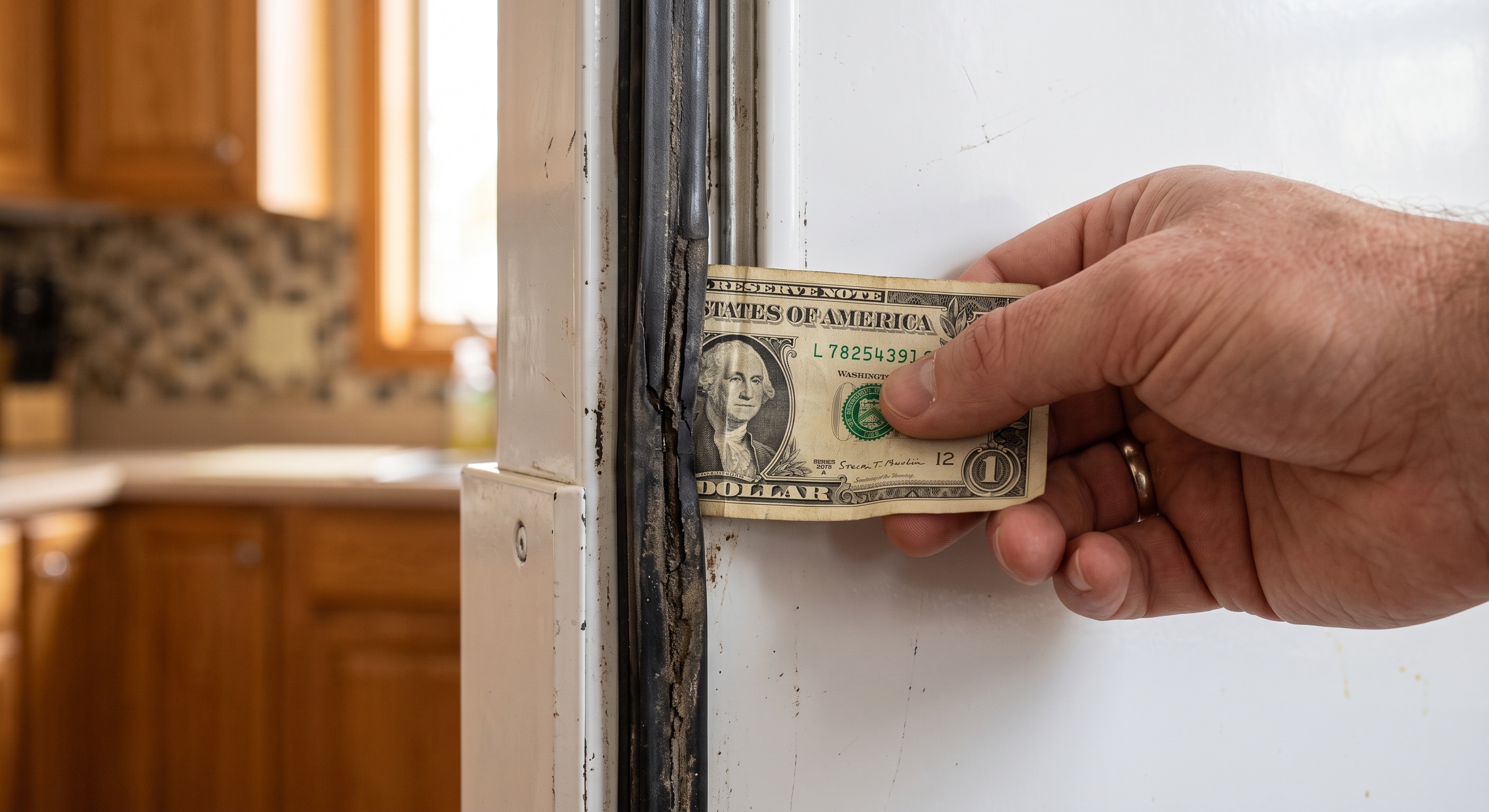
Neither of these checks confirms every possible fault, but both can help identify simple issues before you book a technician for a more detailed diagnosis.
Freezer Cold, Fridge Warm: What That Split Tells You
One of the most useful symptoms to report is a freezer that remains cold while the refrigerator compartment becomes warm.
In many refrigerator designs, the freezer produces much of the cold air used by the fresh-food section. If the freezer is operating normally but the refrigerator is not receiving enough cold air, the problem may involve the evaporator fan, an air duct, a damper, or an airflow restriction.
However, this pattern does not guarantee that the fan or duct is the cause. A faulty sensor, defrost problem, or another component may produce similar symptoms.
Pay attention to the following details:
Is the freezer maintaining its usual temperature?
Is air coming from the refrigerator vents?
Is there excessive frost on the rear freezer panel?
Is the compressor running continuously?
Did the problem develop suddenly or gradually?
Are the refrigerator controls displaying an error?
These details can help a technician narrow the diagnostic process.
If the freezer is cold but the refrigerator is warm, describe the two temperatures separately when you request a diagnosis. The distinction can be more useful than simply saying that the refrigerator is not cooling.
How to Check Whether Your Refrigerator Is Actually Too Warm
Sometimes a refrigerator feels less cold than expected without being dangerously warm. Other times, the temperature has risen enough to put perishable food at risk.
The best way to understand the problem is to use a refrigerator thermometer rather than relying only on how the food or interior air feels.
The U.S. Food and Drug Administration recommends keeping a refrigerator at or below 40°F (4°C) and a freezer at 0°F (-18°C). If perishable food has been held at unsafe temperatures for too long, it may need to be discarded.
If you suspect a cooling problem:
Place a suitable appliance thermometer inside the refrigerator.
Avoid opening the door unnecessarily.
Check the temperature after allowing the appliance time to stabilize.
Compare the reading with the refrigerator's temperature setting.
Check whether the freezer is maintaining its normal temperature.
A warm refrigerator should not be ignored simply because the lights and compressor are still working. If the temperature continues to rise, protect your food and arrange a professional inspection.
When This Stops Being a DIY Job
A few basic checks can help identify simple problems, but there comes a point when continued troubleshooting is more likely to waste time or cause damage.
On refrigerator service calls across White Plains and nearby towns, a unit that appears to have a minor cooling issue may turn out to have a failed fan motor, a defrost-system fault, an electrical problem, or a sealed-system issue.
If cleaning accessible condenser coils and checking the door gasket does not improve cooling, professional diagnosis is the next sensible step. You should also arrange service if:
The compressor runs continuously without maintaining temperature.
The freezer develops heavy or recurring frost.
The refrigerator makes repeated clicking or unusual mechanical noises.
Food is becoming noticeably warmer.
The refrigerator displays an error code.
You notice damaged wiring, burning smells, or signs of overheating.
Do not remove internal panels, handle refrigerant lines, or attempt electrical repairs without the appropriate training and equipment. Refrigerators contain electrical components, moving parts, and sealed refrigeration systems that require careful handling.
A qualified technician can evaluate airflow, fan motors, temperature sensors, the defrost system, compressor operation, and the sealed cooling system. This helps identify the actual cause instead of replacing parts unnecessarily.
If your refrigerator is running but your food is getting warmer, acting early can help protect your groceries and prevent a minor fault from becoming a more expensive repair.
Whether you are in White Plains or another nearby service area, SOS Appliance Repair can help identify the problem and explain your repair options before work begins.
Schedule a refrigerator diagnosis or explore our refrigerator repair services to find the right next step.
- fridge not cold
- freezer cold but fridge warm
- refrigerator warm inside