Local Guides
GE Refrigerator Warming Up: A Failed Evaporator Fan Motor in Englewood
By Michael Smith — Head Technician · October 27, 2026 · 8 min read
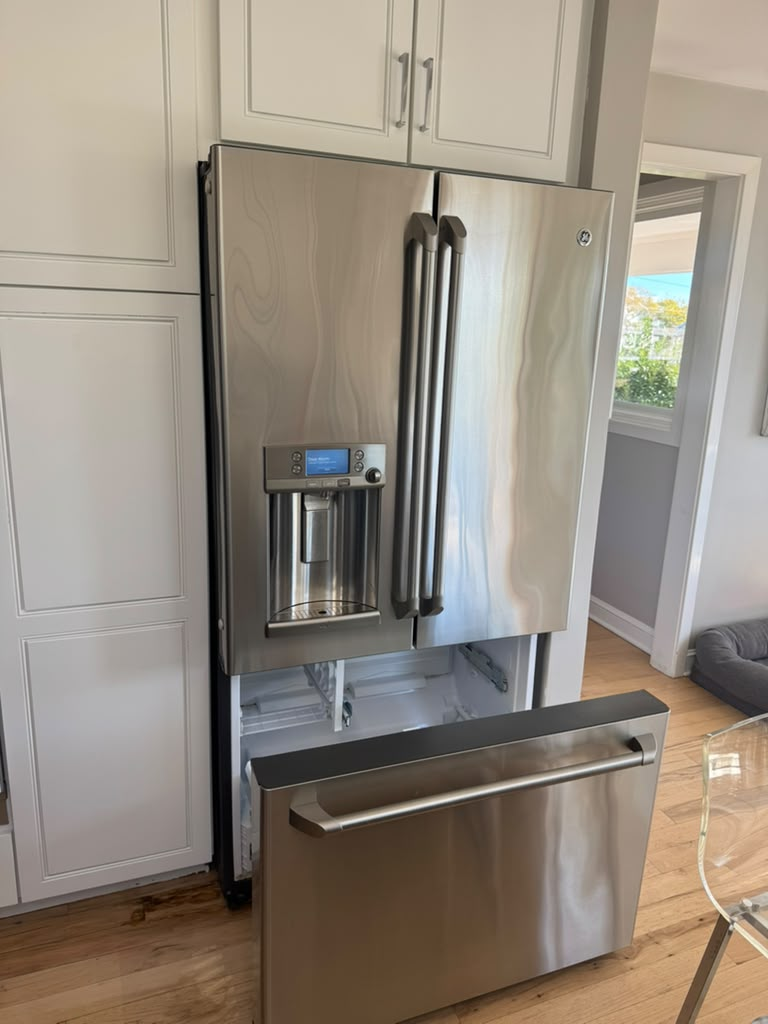
When a GE refrigerator warms up while the freezer stays partly cold, a failed evaporator fan is a common cause. The fan behind the freezer's back wall moves cold air from the coil into both sections. If it stops, the coil stays cold but the fridge warms. Replacing the fan motor restores cooling.
This October 2026 repair in Englewood is a classic refrigerator call: a GE refrigerator warming up in the fresh-food section while the freezer stayed colder, but not as cold as it should be. The cause was a failed GE refrigerator evaporator fan. The motor behind the freezer's back panel had stopped, so the cold air made at the cooling coil was no longer reaching the rest of the refrigerator. Here is how we confirmed it, what we replaced, and how to tell if your refrigerator has the same problem.
Same symptoms at home? Call (800) 631-0109, 24/7, or book online.
Where: Englewood, Bergen County
When: October 2026
Appliance: GE refrigerator
Problem: fresh-food section warm, freezer only partly cold
Cause: failed evaporator fan motor behind the freezer's back panel
Fix: replaced the evaporator fan motor, then checked the airflow and the temperatures
What the refrigerator was doing
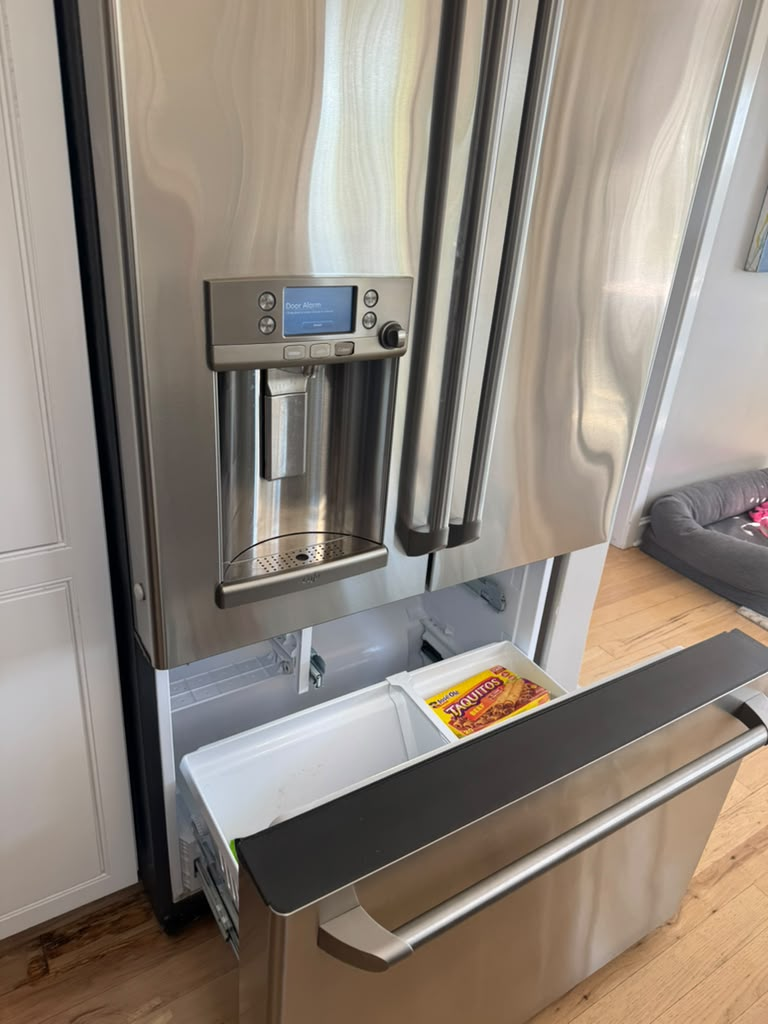
A failed evaporator fan has a recognizable pattern. The fresh-food section warms up first, often over a day or two, while the freezer still feels cold to the hand. Ice cream turns soft long before frozen food thaws, and drinks in the door stop feeling cold. Sometimes the fan gives a warning before it stops: a squeal, chirp or buzz from the freezer that gets louder when the freezer door is closed.
That combination leads many people to think the compressor is failing. It rarely is. A compressor that fails takes the whole refrigerator down, freezer included. When only part of the refrigerator warms up, the problem is usually the air, not the refrigerant.
How cold air moves in a GE refrigerator
A frost-free refrigerator makes all of its cold air in one place: the evaporator coil, hidden behind the back panel of the freezer. The coil gets very cold, and the evaporator fan pulls air across it and pushes it out through vents into the freezer. Part of that air carries on through a duct and an air damper into the fresh-food section. The fridge side has no cooling system of its own.
That's why a stopped fan produces such a lopsided result. The freezer sits right next to the cold coil, so it stays fairly cold for a while even with no air moving. The fresh-food section depends entirely on the fan to send cold air its way, so it warms up first and fastest.
What we checked behind the freezer panel
Several faults look alike from the outside, so we tested instead of guessing. With the freezer emptied and the evaporator cover removed, we checked three things in order:
The evaporator coil. A light, even frost on the coil means the defrost system is doing its job. A solid block of ice points to a defrost fault instead, which is a different repair.
The fan blade. It should turn freely by hand. Ice around the blade, or a bearing that drags, stops it.
Power at the motor. On many GE models the evaporator fan is a low-voltage motor run by the main control board. We test the voltage at the motor's plug while the refrigerator is calling for cooling. Power with no rotation means the motor has failed; no power points to the board or the wiring.
On this refrigerator the checks pointed to the evaporator fan motor itself, so the motor was the part to replace. Testing before ordering matters: a new fan does nothing for a refrigerator whose board has stopped sending it power.
The fix
We replaced the evaporator fan motor with the correct part for the model and refitted the evaporator cover. Then we confirmed the new fan ran when it should, with the compressor running and the freezer door closed, and that cold air was coming out of the vents in the fresh-food section. Air at those vents proves the duct and the damper are clear too.
After a repair like this, the refrigerator needs a few hours to bring the fresh-food section back down to temperature, and up to a day to settle completely. The FDA's food safety guidance is 40 °F or below for the refrigerator and 0 °F for the freezer, and an inexpensive appliance thermometer is the easiest way to check both.
Why a GE refrigerator evaporator fan fails
The evaporator fan runs for many hours a day, every day, for years. Most failures come down to one of three things:
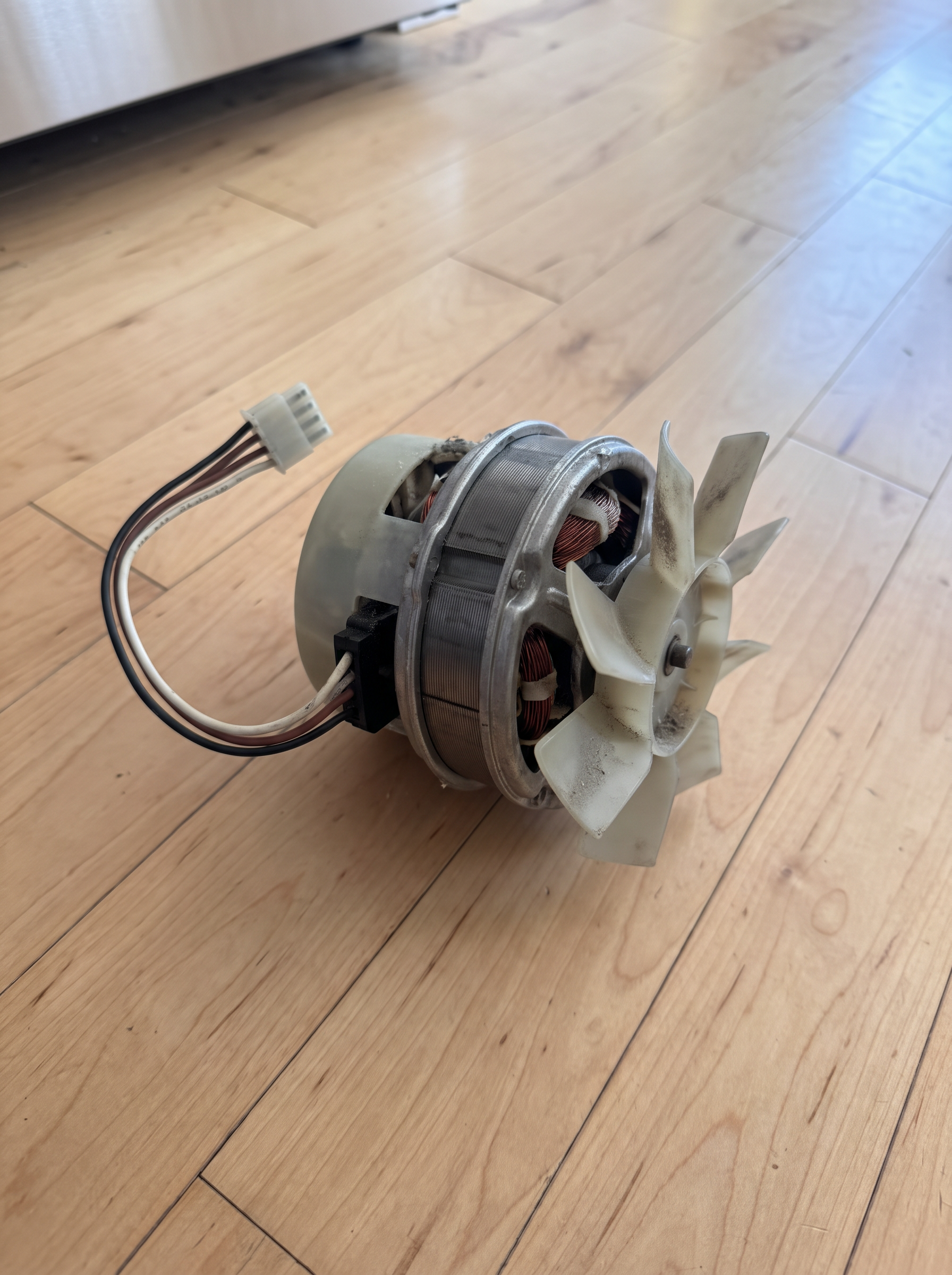
Worn bearings. The most common cause. As the bearings dry out, the motor gets noisy, with a squeal, chirp or growl from the freezer, and slows down until it stops.
Ice on the blade. When frost builds up around the fan, the blade hits ice, the motor strains, and it can burn out. A freezer door left ajar, a torn gasket or a defrost problem causes that frost.
An electrical failure. The motor's winding can fail, or, less often, the circuit on the control board that powers it. That's why the voltage test comes before ordering a part.
How to tell if your refrigerator has the same problem
You can check most of this yourself, without tools:
Compare the two sections. If the freezer is still cold but the fresh-food side is warm, an airflow problem moves to the top of the list. A fridge not cooling while the freezer still works is the classic sign.
Listen in the freezer. On many GE models the fan stops when the freezer door opens. Open it and press the door switch, the small button or lever in the door frame. If the compressor is running, you should hear the fan within a few seconds. Silence points to the fan. A squeal or grinding means it's on its way out.
Feel the vents. Hold your hand near the air vents in the fresh-food section while the compressor runs. Little or no cold air means the air isn't arriving.
Look at the freezer's back wall. A thin, even frost is normal. Thick ice on the back panel points to the defrost system instead.
Rule out the simple things. Make sure food isn't blocking the vents, both doors close fully, and nobody has changed the temperature setting.
If the whole refrigerator is warm, freezer included, or the compressor clicks on and off, the problem is elsewhere: the condenser fan, the compressor's start parts or the control board. Our refrigerator repair page covers those.
Problems that look like a failed evaporator fan
Several faults produce a warm fridge with a colder freezer, and each one needs a different part:
A failed defrost heater or sensor. The evaporator coil ices over and blocks the air, and the fan may scrape on the ice. Thick frost on the back wall is the giveaway. We fixed exactly that on a Samsung refrigerator in Englewood earlier this month: read the defrost heater story.
A stuck air damper. The damper controls how much freezer air reaches the fridge. If it's stuck closed or frozen, the fan runs but the fresh-food section stays warm.
A control board fault. The fan motor is fine, but it never receives power.
A failed condenser fan. That fan sits at the back, near the compressor. When it stops, both sections warm up and the compressor runs hot.
A door that doesn't seal. Warm, humid air leaks in, frost builds up near the door, and the refrigerator runs almost nonstop.
What to have ready when you call
The model number speeds everything up, because it tells us which fan motor and control board the refrigerator uses. On most GE refrigerators it's on a label inside the fresh-food section, on a side wall or near the top. It also helps to say when the warming started, whether you hear any noise from the freezer, and whether there's frost on its back wall.
Is a failed evaporator fan worth repairing?
In almost every case, yes. The sealed system, the compressor, coil and refrigerant that make a refrigerator expensive, was untouched here. An evaporator fan motor is a modest part, and replacing it restores normal cooling. The calculation only changes on an old refrigerator that also has a failing compressor or a cracked liner. Our GE appliance repair page has more on GE refrigerators and the other GE appliances we repair.
Keeping food safe while it's warm
Until the repair, keep both doors closed as much as you can, so the cold that's left stays in. Move meat, dairy and leftovers into the freezer or into a cooler with ice. Throw away perishable food that has sat above 40 °F for 2 hours or more; when in doubt, throw it out. An appliance thermometer in the fresh-food section tells you where you stand.
How to keep it from coming back
Keep the vents inside both sections clear of food, so the fan isn't pushing against a blocked duct.
Check the door gaskets twice a year. Close a sheet of paper in the door; if it slides out with no resistance, the seal needs attention.
Don't leave the freezer door ajar. Humid kitchen air turns into frost, and frost is what stalls a fan.
If a new squeal or chirp starts in the freezer, get it checked early, before the fan stops and the fridge warms up.
Refrigerator repair in Englewood and nearby
We repair refrigerators, freezers and ice makers in Englewood and across Bergen County, GE and the other major brands. See our Englewood page for the area we cover there, or our refrigerator troubleshooting page for other symptoms. GE publishes owner's manuals and support information for its refrigerators on its service and support site.
- ge refrigerator
- evaporator fan motor
- fridge not cooling
- Englewood