Local Guides
GE Cooktop Burner Not Heating: A Failed Radiant Element in Hackensack
By SOS Appliance Repair · November 2, 2026 · 7 min read
Technician credentials: EPA 608 Universal · Sub-Zero Factory Certified
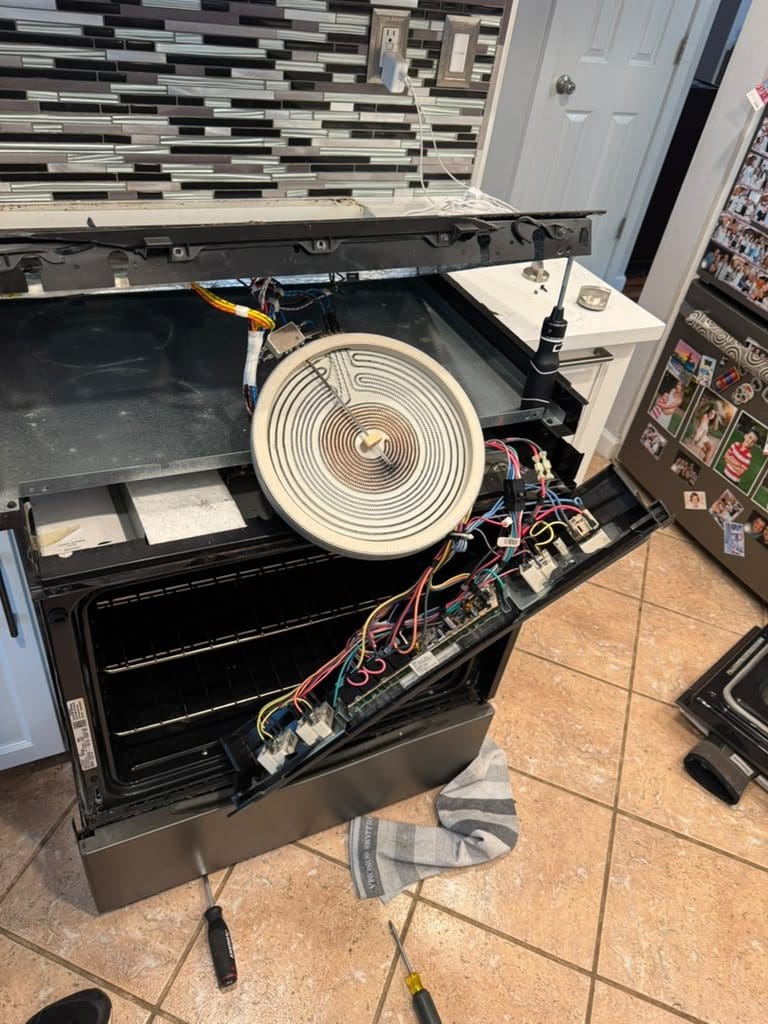
When one burner on a GE cooktop won't heat but the others work, the radiant element under the glass is a common cause. The switch, the control board or a loose wire can look the same, so a meter test comes first. Replacing a failed element restores the burner.
This October 2026 repair in Hackensack is a common call for a glass cooktop: a GE cooktop burner not heating while the other burners worked normally. The cooktop was a GE built-in electric model, and the cause was a failed radiant surface heating element under the glass. Here is how we confirmed it, what we replaced, and how to tell if your cooktop has the same problem.
Same symptoms at home? Call (800) 631-0109, 24/7, or book online.
Where: Hackensack, Bergen County
When: October 2026
Appliance: GE built-in electric cooktop
Problem: one burner not heating, the others working normally
Cause: failed radiant surface heating element
Fix: replaced the element, then tested the burner on low and on high
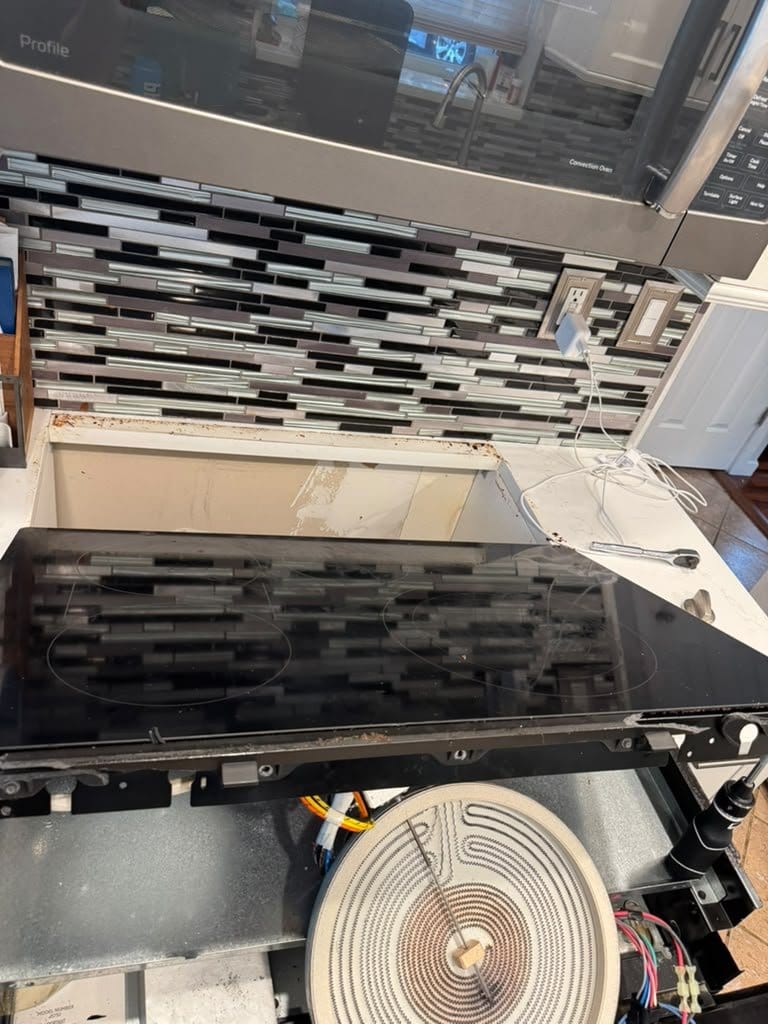
What the cooktop was doing
A failed radiant element has a simple pattern. You turn the knob or press the control for one burner and nothing happens: no glow under the glass and no heat in the pan. The other burners work as usual, so power is reaching the cooktop and the problem is limited to one position.
That single-burner pattern matters, because it rules out a lot. When several burners stop at once, we look first at the breaker, the wiring to the cooktop or the main control. When only one stops, the search narrows to the parts that serve that burner alone.
How a radiant burner works
A glass cooktop looks like one flat surface, but each burner is a separate unit underneath. The radiant element is a thin ribbon of resistance metal laid in a shallow insulated dish, pressed up against the underside of the glass. When power reaches it, the ribbon glows red and heats the glass and the pan above it.
Each radiant surface element has three partners. On models with knobs, an infinite switch sets the heat by turning the element on and off in cycles. On models with touch controls, a control board does the same job. A small rod across the element, the heat limiter, cuts power for a moment if the glass gets too hot, which protects the glass from cracking. The wires connecting them carry 240 volts, which is why a burner that looks simple still needs a careful test.
What we checked on the GE cooktop
Several faults look identical from above, so we tested instead of guessing. With the power off at the breaker, we worked through the parts that serve that one burner:
The connections. Heat can loosen or burn the terminals on an element. A scorched wire end or a loose connector stops the burner even when every part is good.
The element. A meter across the element's terminals shows whether its circuit is complete. A healthy element gives a steady resistance reading. No reading means the ribbon or the limiter has opened.
The control. With the element ruled in or out, the switch or the control board is checked for power to that burner. Replacing an element does nothing if the control behind it has stopped sending power.
On this cooktop the checks pointed to the element itself, so the radiant surface heating element was the part to replace.
The fix
We replaced the radiant surface element with the correct part for the model, reconnected the wiring, and refitted the cooktop. Then we restored power and tested the burner, first on a low setting and then on high. We watched for an even glow across the element and confirmed that it cycled the way it should.
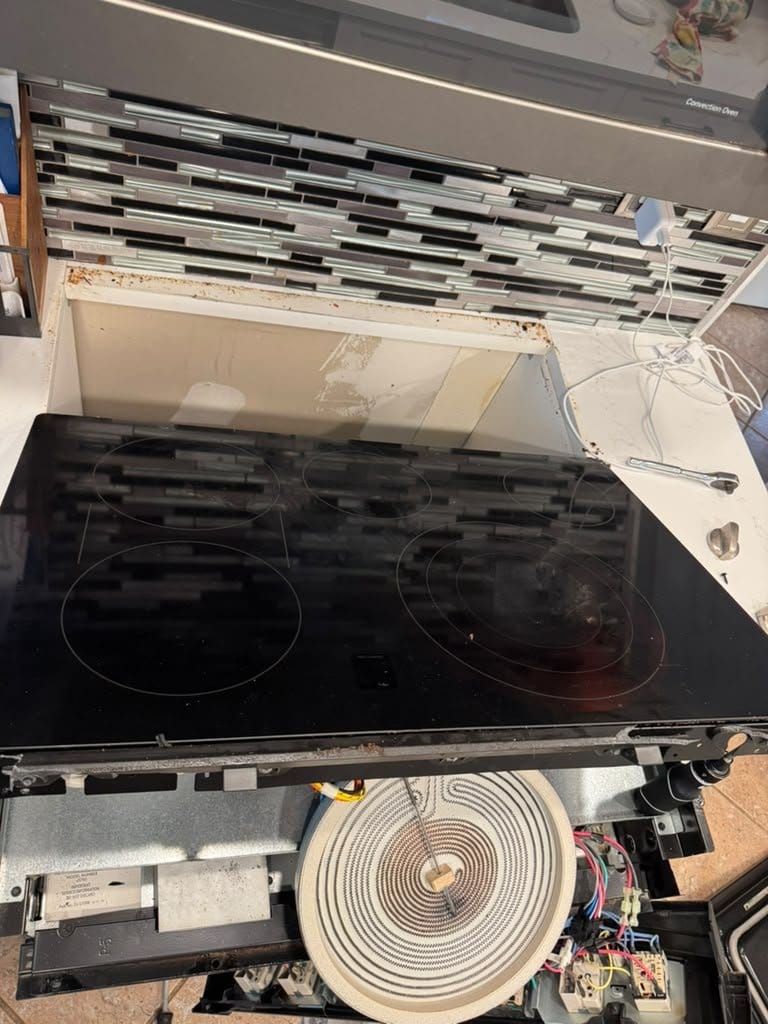
Why a GE cooktop burner stops heating
A radiant element heats up and cools down thousands of times over its life, and that wears it out. Most failures come down to one of these:
Age and heat cycles. The ribbon gets brittle with years of use and eventually breaks. This is the most common cause, and the burners used most often tend to go first.
Pans that hold heat against the glass. Warped pans, or pans much larger than the burner, make the element work harder and trip the limiter again and again.
A failed limiter. On many elements the limiter is built in, so when it fails the whole element is replaced.
A heavy knock. A pan dropped on the glass can damage the fragile ribbon underneath, even when the glass survives.
How to tell if your cooktop has the same problem
You can check most of this yourself, without tools or opening anything:
Try each burner. If only one burner is dead, a part serving that burner is the likely cause. If several are dead, check the breaker first.
Look for the glow. Turn the burner to high and wait a minute. A radiant element normally glows red through the glass. No glow at all points to the element, its wiring or its control.
Check for a partial glow. On a dual burner, the inner and outer rings can fail separately. If one ring glows and the other doesn't, tell us when you call.
Test with a pan of water. Some burners heat weakly without much visible glow. If a pan of water never warms up, the burner has a real fault.
Inspect the glass. Look for cracks or chips around the burner. If the glass is cracked, stop using the cooktop and turn it off at the breaker.
Problems that look like a failed element
Several faults leave a burner cold, and each one needs a different part:
A failed infinite switch. The element is fine but never receives power, or the burner sticks on high and won't turn down. A burner stuck on high is usually the switch, not the element.
A control board fault. On touch models, one output on the board can fail and stop one burner, or the keypad can stop responding.
A burned terminal or loose wire. This often shows as a burner that works sometimes and cuts out at others.
A half-tripped breaker. Electric cooktops use a double breaker. If one side trips, some burners can stop while others keep working.
What is normal on a radiant cooktop
Some behavior worries people but isn't a fault. A radiant burner turns on and off by itself, even on high, because that's how it holds the temperature. The glow can fade and return during cooking. The hot surface light stays on after the burner is off, until the glass has cooled. None of that needs a repair.
What to have ready when you call
The model number speeds everything up, because it tells us exactly which element and control the cooktop uses. On a built-in GE cooktop it's usually on a label on the underside of the unit, which you can often see from inside the cabinet below. It also helps to say which burner is affected, whether it glows at all, and whether the cooktop has knobs or touch controls.
Is a failed element worth repairing?
In most cases, yes. A built-in cooktop is fitted to a cutout in your counter, so replacing it can mean finding a model that fits the same opening. A failed element is one part serving one burner, and changing it leaves the glass and the rest of the cooktop in place. The calculation changes if the glass is badly cracked or the cooktop is very old. Our GE appliance repair page covers the other GE appliances we repair.
How to keep it from coming back
Use flat-bottomed pans that match the size of the burner, and replace pans that rock on the glass.
Lift pans rather than sliding them, and take care with heavy pots.
Don't leave an empty pan on a hot burner.
Clean spills once the glass has cooled, using a cleaner made for glass cooktops.
Never store anything on the cooktop. The National Fire Protection Association's cooking safety advice is to keep anything that can burn away from the stovetop.
Cooktop repair in Hackensack and nearby
We repair cooktops, ranges and ovens in Hackensack and across Bergen County, GE and the other major brands. See our Hackensack page for the area we cover there, our oven and range repair page for more about the service, or our oven and range troubleshooting page for other symptoms. GE publishes owner's manuals and support information for its cooktops on its service and support site.
- ge cooktop
- radiant surface element
- cooktop burner not heating
- Hackensack