Service
Ice Maker Repair Across North Jersey, Rockland, Westchester & Fairfield
Licensed, insured & backed by a 12-month warranty
Standalone and built-in ice maker repair for water inlet valves, ice module faults, leaks, and full unit replacement.
5.0 from 36 Google reviewsBefore you book
Common ice maker problems
Before you book, it helps to know what actually tends to go wrong. These are the ice maker faults we see most often, what typically causes each one, and what it means for you — not a diagnosis, just a plain-language starting point.
Water inlet valve failures
The water inlet valve that feeds the ice maker is the single most common failure point in the whole system. It's an electrically controlled part, separate from the refrigerator's main water supply connection, and it can fail in either direction — closed, which stops ice production outright, or not sealing fully, which causes a slow drip that shows up as extra frost or a small puddle inside the freezer rather than an obvious leak anywhere visible.
Ice module or motor faults
The ice module is the self-contained mechanism that actually forms each batch of cubes and ejects them into the bin on a timed cycle. A failing module can produce cubes that are small, hollow, or oddly shaped, or it can stop cycling altogether while the rest of the refrigerator or freezer keeps cooling completely normally around it.
Frozen supply lines
A supply line that's frozen solid cuts off water to the ice maker in exactly the same way a failed inlet valve does, but the fix is different — the line has to be located and thawed, and whatever's actually causing it to freeze in the first place, often a kink or a spot pressed too close to a cold surface, addressed so it doesn't just refreeze.
Leaks at the fill tube
A cracked, misaligned, or partially blocked fill tube lets water drip inside the freezer cabinet instead of reaching the ice mold cleanly, which shows up as unexplained ice buildup in the wrong spot or water pooling at the bottom of the freezer rather than an obvious leak underneath or behind the unit.
Small, hollow, or off-tasting ice
Ice that comes out small, hollow, or cloudy usually points to a water pressure or fill-time problem at the module rather than the cooling system; ice that tastes or smells off is almost always a water-line or filter issue rather than anything mechanical, and both are worth ruling out before assuming a part has failed.
Won't stop running or cycling continuously
An ice maker that keeps trying to harvest without ever properly stopping usually has a stuck shut-off arm or a failing sensor that's supposed to tell the module the bin is full. It's a separate fault from a slow or absent ice maker, and it's worth having addressed rather than ignored, since it typically means the unit is drawing water and running its motor far more than it needs to.
Symptoms
What's wrong with your ice maker?
Pick the closest match — it pre-fills your booking so we arrive with the likely part.
Diagnosis
How we diagnose a ice maker problem
Every visit starts with a diagnosis, not a guess. Here's what your technician checks, in order, before recommending a repair.
- 1
Water inlet valve
We test the inlet valve for proper flow and shutoff, since a weak or stuck valve is the most common reason for slow, small, or hollow cubes.
- 2
Supply line for freezing or blockage
A partially frozen or kinked supply line can stop ice production without the valve itself being at fault, so we check the full line, not just the valve.
- 3
Ice module motor & thermostat
The module's motor and thermostat control the harvest cycle — a fault here shows up as a maker that fills with water but never ejects cubes.
- 4
Fill tube for leaks
We check the fill tube and its seal for the slow leaks that show up as water pooling in the freezer rather than at the unit itself.
On site
What the visit looks like
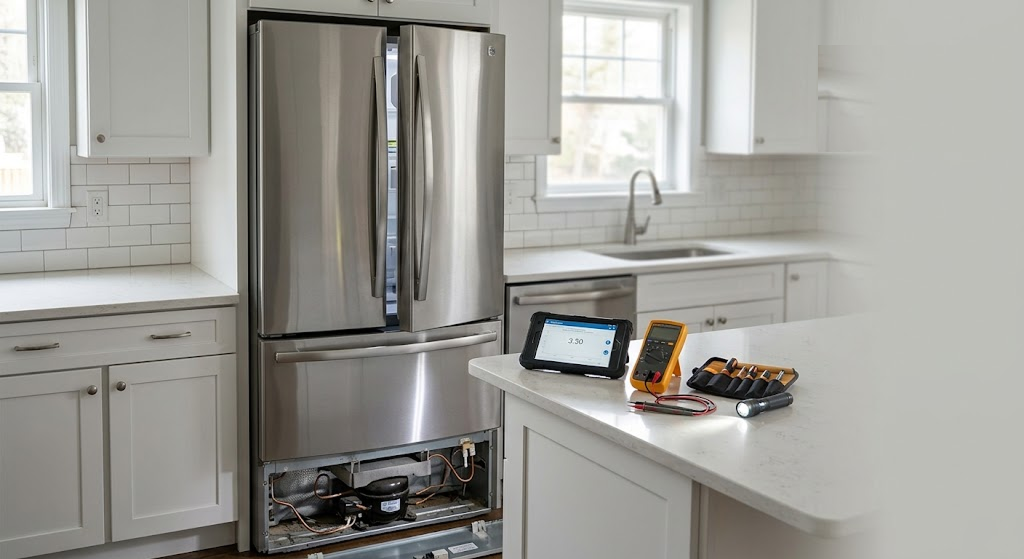
Your technician arrives inside the agreed window, in a marked vehicle and with photo identification. You get their name and photo by text before they set off.
They diagnose the fault, explain in plain language what has failed, and hand you a written estimate. Nothing proceeds until you approve it.
Most repairs finish in the same visit. Where a part has to be ordered we book the return before leaving, and you are not charged a second diagnostic.
Process
How the repair works
- 1
Tell us what's wrong
Call or book online in under three minutes. A photo of the model plate speeds things up.
- 2
Pick a 3-hour window
Real availability including same-day. We text when your technician is on the way.
- 3
We diagnose and quote
We diagnose the fault first. Written estimate before any work starts.
- 4
Approve — we fix it
Most repairs finish the same visit, backed by a 12-month warranty.
Included
What every repair includes
- 12-month parts and labor warranty
- Written estimate before work begins
- Background-checked, uniformed technician
- Licensed and insured
- Clean-up after the repair
- Invoice emailed with a secure pay link
Brands
Brands we service for ice maker repair
Factory training on premium built-ins, and strong parts availability across the mainstream lines.
Questions
Ice Maker Repair FAQ
How much does ice maker repair cost?
Cost depends on what's actually wrong, so SOS Appliance Repair diagnoses before quoting rather than pricing blind over the phone or online. Call us to talk through pricing for your situation, and you'll always get a written estimate on site before any work begins.
How quickly can you carry out ice maker repair?
SOS Appliance Repair offers same-day ice maker repair across our six-county service area in New Jersey, New York and Connecticut when you book before 2 PM.
Is ice maker repair covered by a warranty?
Every ice maker repair performed by SOS Appliance Repair carries a 12-month warranty on both parts and labor, stated in writing on your invoice. If the same fault returns within that period we come back at no charge.
Related
Other services
Same-day appointments available
Broken appliance? We can be there today.
Talk to the company that actually sends the technician — no lead brokers, no bidding wars, no runaround.
- Licensed & insured
- 12-month warranty
- Background-checked technicians